A verdict on Russia's imperial ambitions. What the Berlin Declaration actually changes
European leaders are changing the continent's security architecture
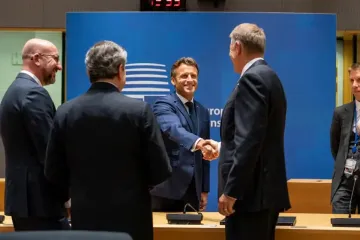
Eduard Rubin draws attention to the fact that the document was signed by heavyweights: German Chancellor Friedrich Merz, French President Emmanuel Macron, British Prime Minister Keir Starmer, European Commission President Ursula von der Leyen, as well as the leaders of Italy, Poland, the Netherlands, Norway, Sweden, Finland, and Denmark.
The expert made a detailed analysis of the 6 main points of the Berlin Declaration.
1. Peacetime Army: 800,000 bayonets
Quote: "Provide sustained support to Ukraine to create an armed force, the number of which should remain at the level of 800,000 people..."
What does this mean:
This is the end of any talk of “demilitarization.” The West officially signs off on the fact that Ukraine will have the largest army in Europe. For comparison: the Bundeswehr plans to reach 203,000 by 2031.
Ukraine will keep almost a million people at gunpoint. This is not just defense, it is the most powerful deterrent. Such an armada, equipped with Western weapons, makes any attempt at a new blitzkrieg by the Russian Federation suicidal.
2. European Legion: "Coalition of the Determined"
Quote: "European "Multinational force Ukraine", formed from willing countries... with the support of the USA."
What does this mean:
For the first time, the deployment of foreign troops has been officially announced. The wording of "assistance in reconstruction," "protection of the skies," and "safety at sea" is freeing.
This is “NATO-lite.” Alliance troops are entering Ukraine not under the NATO flag (so as not to scare Washington), but as a “Coalition of the Willing.” They will take over the rear, logistics, air defense, and border security with Belarus and Transnistria, freeing up combat units of the Armed Forces of Ukraine for the eastern front.
3. American surveillance
Quote: "US-led ceasefire monitoring mechanism with international participation."
What does this mean:
Trump doesn't want to send soldiers, but he's ready to be a "sheriff." The Americans will lead a monitoring mission. This is a guarantee that any violation of the "silence" by the Russian Federation will be recorded not by the toothless OSCE, but by representatives of Washington. And shooting at the American flag is a bad sign even for the Kremlin.
4. Legal guarantees (instead of the Budapest Memorandum)
Quote: "Legally binding security guarantees: in the event of an attack, the obligation to respond with military, intelligence, and economic measures."
What does this mean:
This is the same "Article 5", but written into bilateral agreements. If Russia twitches again, Europe undertakes not to "express concern", but to enter the conflict: to provide weapons, intelligence and send in troops.
5. Aggressor's money
Quote: "Russian assets in the EU remain frozen."
What does this mean:
Putin hoped to negotiate the unfreezing of assets in exchange for peace. It didn't work out. The money remains hostage and, apparently, will go to the same "Marshall Plan" for Ukraine. The recovery economy will be built on the confiscated billions of Russian rubles.
6. The path to the EU
Quote: "Support for Ukraine's accession to the EU."
What does this mean:
This is a political point of no return. Ukraine is finally leaving the orbit of the "Russian world" and entering the economic and political space of Europe.
According to Rubin, this document is the result of a tough compromise between Trump's desire to quickly end the war and Europe's fears of being left alone with Putin.
Trump gets: peacemaker laurels, stopping the hot phase and shifting financial costs to Europe. Europe gets: a buffer zone protected by an 800,000-strong army. Ukraine gets: survival, security guarantees, money for reconstruction and the prospect of the EU, albeit at the cost of painful territorial compromises (de facto, but not de jure).

Eduard Rubin
Ukrainian scientist and entrepreneur
In addition, this decision will drive Putin into a strategic dead end, because instead of a weak neutral country near the borders, there will be a military monster integrated into the West.
Berlin on December 15, 2025, will go down in history textbooks as the day when Europe stopped being afraid and began to act, Rubin believes.
Latest news






 more news