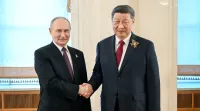
Kremlin eyes elections as alternative path to power in Ukraine
global.espreso.tv
Thu, 11 Dec 2025 11:42:00 +0200
But what is the danger of holding elections during wartime? And what risks do the statements of the state leadership about their readiness to organize them "in 60–90 days" carry?1. It is worth recalling that a change of power in Ukraine is one of Putin's primary demands in his long list. At the beginning of the 2022 invasion, they expected to change power by force. That failed then, but the Kremlin today still retains optimism about installing its puppet in Kyiv.Fictitious stories about Russian soldiers being met with flowers only strengthen their belief in the prospects of pro-Russian candidates winning elections. That is why every "peace memorandum" project includes a clause about holding elections.2. It is already clear that the Kremlin will not sign any documents with Zelenskyy. Putin perceives a peace agreement as a tool to solidify his own victory, so another president of Ukraine must sign it.Accordingly, the Kremlin views elections as an alternative way to change power. This means that if an election campaign starts, Russia will influence it as aggressively as possible.3. It is not difficult to imagine what elections during wartime would look like in the Kremlin's fantasies.The holding of elections will be accompanied by a whole package of Russian demands: full access for pro-Russian parties, the return of Russian media and propaganda, the registration of all traitors and separatists as candidates — from Medvedchuk to Azarov.And all this will be presented to Americans as "free elections" and "freedom of speech." For some of the American establishment, such argumentation may indeed seem convincing, and it will be broadcast to us.As a result, Ukraine will be presented with conditions for an "election truce." Outwardly, they will look completely democratic to those who do not understand the Ukrainian context: "In the EU and the U.S., there are no banned parties, Russian media are not shut down, propaganda is part of the election process. We want the same in Ukraine."If this cannot be stopped quickly, then after several months of negotiations about an election truce, some "compromise" will emerge. Its content is difficult to predict, but the participation of candidates with Kremlin support in the elections will remain in any scenario.During the campaign, pro-Russian candidates will say: "See, now there are no bombings, no missiles flying, no one is being killed at the front. If you want it to continue this way — vote for a conditional Medvedchuk." And if not — there will be missiles, shelling, and the front again. And the Russian army, meanwhile, will stand along the demarcation line, reminding how and for whom "one should vote."In parallel, campaigns to curtail Ukrainian identity will be promoted. The slogans "Language, Faith, Army" will return — but in a different sense: "Vote correctly — and you will again be able to listen to normal Russian music, children will not 'distort Ukrainian,' the Territorial Recruitment Centers will be disbanded, and the Russian church will return to every village."4. Obviously, Ukraine critically needs elections. As an opposition politician, I have no sentiments regarding the current government. But holding elections during wartime carries obvious threats that can lead to catastrophic consequences. That is why the Constitution and laws directly prohibit elections during martial law.There should be no doubt: the destruction of independent Ukraine is one of Putin's key goals. How this will be achieved — militarily, diplomatically, or through elections — are just details for the Kremlin. The task of the government and society is to prevent this. Elections in Ukraine can only take place on Ukrainian terms.SourceAbout the author. Mykola Kniazhytskyi, journalist, Ukrainian lawmaker.The editorial board does not always share the opinions expressed by the authors of blogs or columns.
Latest news




 more news