Germany accuses Russia of large-scale cyberattack and disinformation campaign
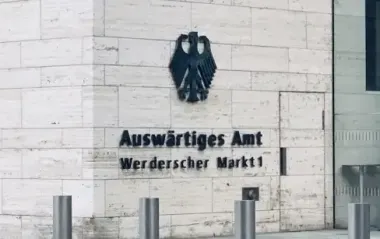
Moscow is guilty of espionage and cyberattacks against Germany — German Foreign Ministry
This was stated by German Foreign Ministry spokesman Martin Giese at a briefing on December 12.
According to the diplomat, the analysis of German intelligence allows proving Moscow's responsibility for individual facts of "espionage and cyberattacks, including sabotage attempts."
Using two national attribution methods, we can trace the following: First, we can now clearly attribute the cyberattack on the German air traffic control service in August 2024 to the hacking collective APT 28, also known as Fancy Bea. Our intelligence proves that the Russian military intelligence service GRU is responsible for this attack. Second, we can now definitively state that Russia, through the “Storm 15” campaign, attempted to influence and destabilize the internal affairs of the Federal Republic of Germany, including the recent federal elections.
In particular, he noted, there is reliable information that the Moscow think tank "Center for Geopolitical Expertise" and the "Two-Headed Eagle Movement" are behind this campaign. They are supported by the Russian military intelligence agency GRU, Giese added.
The analysis shows that artificially generated supposedly investigative materials, deepfake videos, pseudo-journalistic websites, and fabricated testimonies are being distributed on various platforms.
The purpose of these Russian cyberattacks and disinformation attacks is clear: to divide society, sow distrust, provoke rejection and weaken trust in democratic institutions. This targeted manipulation of information is part of numerous Russian actions aimed at undermining trust in democratic institutions and processes in Germany. Russia thus poses a very real threat to our security, not only through its aggressive war against Ukraine, but also here in Germany.
Therefore, the Russian ambassador was summoned to the Ministry, and he was made clear that the German side was very closely watching what Russia was doing and would counteract it.
We are absolutely confident in the results. And the Russian ambassador certainly understood them too — he doesn't need lengthy evidence to understand what we're talking about. We can prove it, ... it's solid evidence. It's unequivocally, unquestionably confirmed.
The spokesman assured that Russia's unacceptable actions have consequences. Thus, in close coordination with European partners, Germany is taking a number of countermeasures aimed at stopping Russia's hybrid activities. In addition, new individual sanctions against hybrid actors are supported at the European level, which will include entry bans, asset freezes and a ban on the provision of economic resources. Giese clarified that from January 2026, Germany, together with EU partners, will, in particular, control cross-border travel of Russian diplomats in the Schengen area.
The goal is to ensure better information sharing and minimize intelligence risks.
Additional bilateral restrictions are also being introduced for Russian diplomatic personnel.
The Ministry of Internal Affairs, for its part, confirmed that it was investigating both cases. Since June 2024, the Central Service for Detecting Foreign Information Manipulation (CMM) has been operating in this ministry, together with other departments, to ensure the early detection of foreign influence and manipulation campaigns, to analyze methods, distribution channels and mechanisms of influence in social networks and on the Internet. It is also planned to create a new central platform for interdepartmental exchange and coordination of measures to counter hybrid threats to create a general situational picture and assess individual data.
Latest news


 more news